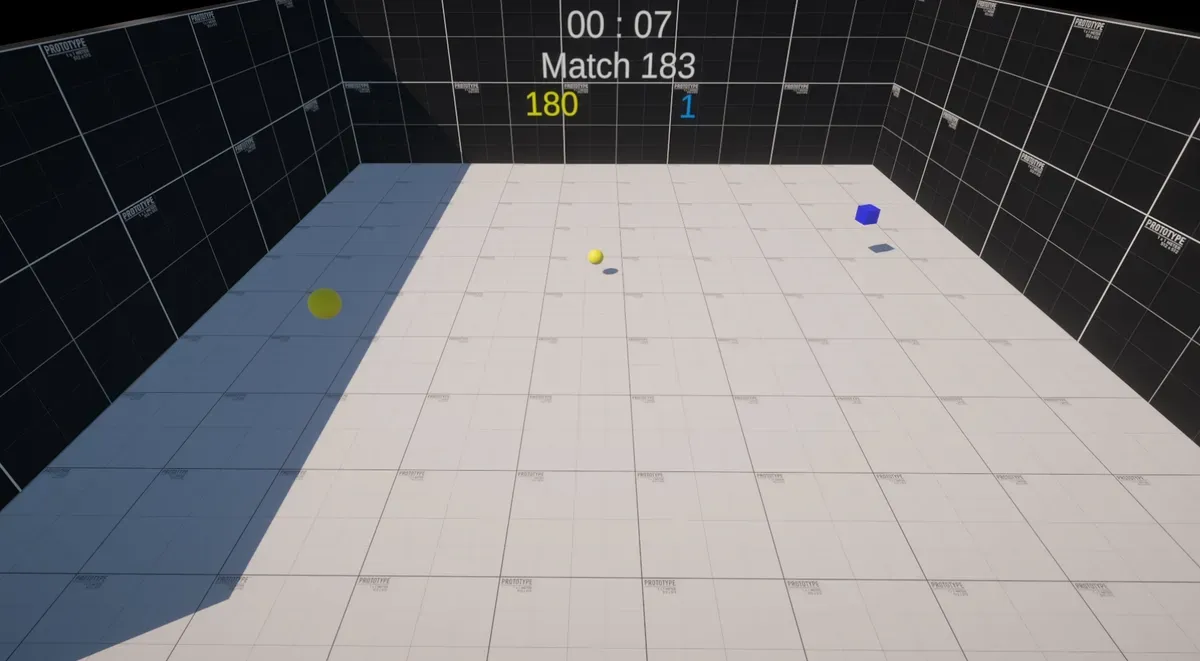
Context: Solo research project at Spielworks GmbH (2024) exploring ML-driven creature AI for potential integration into the Spielworks AI platform.
The Concept
What if game creatures didn't follow scripted behavior — but actually learned to fight? Not randomized, not behavior trees, but genuine emergent strategies developed through generational training.
I prototyped this using Chainmonsters-style creatures: autonomous agents that learned movement, positioning, and combat through reinforcement learning, developing their own fighting styles over hundreds of thousands of generations.
Technical Approach
Stack: Unity ML-Agents with external Python neural network
Agent context (intentionally limited):
- Position and rotation
- Health points
- 3 abilities with independent cooldowns
- Opponent state (same parameters)
Goal: Survive. Defeat the opponent. 1v1 battles.
Curriculum learning: Training happened in phases:
- Movement — Agents learned navigation through obstacle courses, with goals and avoidance rules (maintain safe distance from opponents)
- Combat — Battle mechanics layered on top of trained movement
This sequencing was critical. Movement competence had to exist before combat made sense.
What Emerged
Early generations tried to close distance immediately — a holdover from movement training where reaching a goal was rewarded. But since direct contact dealt minor damage, this behavior was penalized. Over subsequent generations, agents learned spacing and approach timing.
Training scale:
- Movement competence: ~100K generations
- Combat competence: ~500K generations (against a single opponent type)
The limitation: agents were only trained against one creature type, so they developed specialized strategies rather than generalized combat intelligence. Multi-opponent training was the logical next step.
Where This Goes
The prototype proved the concept: creatures can develop genuine fighting styles through generational learning rather than scripted behavior. Applied to a live game, this could mean:
- Player-owned creatures that evolve unique strategies
- Background training that continues between play sessions
- Emergent meta-games as creature populations develop counter-strategies
This remains a research prototype, but the foundation is there.