Challenge
In 2017, I started building Chainmonsters from my university dorm room — a real-time multiplayer monster-taming MMO with true player ownership through blockchain. At the time, "blockchain gaming" meant speculative tokens and vaporware. There was no playbook for connecting Unity to Ethereum, no established UX patterns for wallets and gas fees, and no proof that players would accept this model.
The goal was ambitious: build a legitimate free-to-play MMO with all the production value players expect, while pioneering blockchain integration that enhanced rather than hindered the experience. Self-funded from day one.
Solution
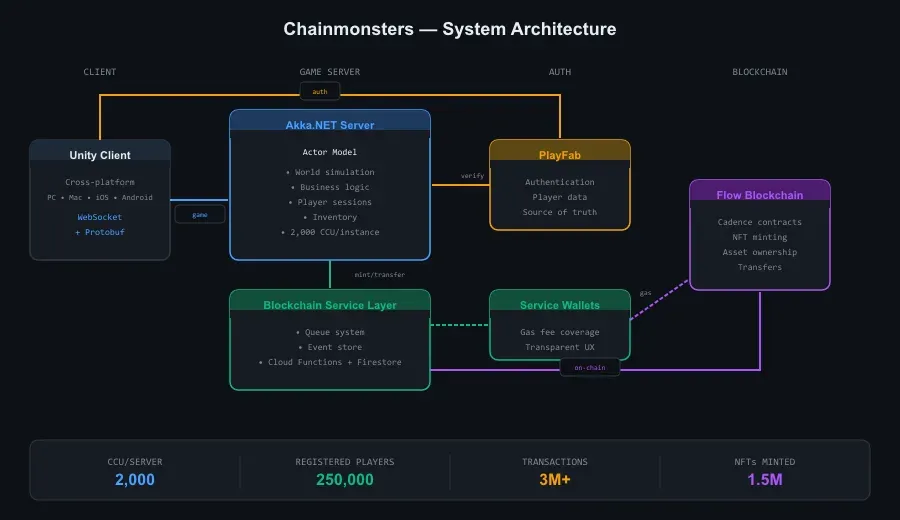
Server Architecture (Akka.NET + Azure): The backend ran on custom .NET Akka servers hosted on Azure — Akka.NET was the mature Actor model implementation at the time (Orleans hadn't yet gained traction). Each server instance handled approximately 2,000 concurrent players in a fully server-authoritative model. PlayFab managed account authentication and player data.
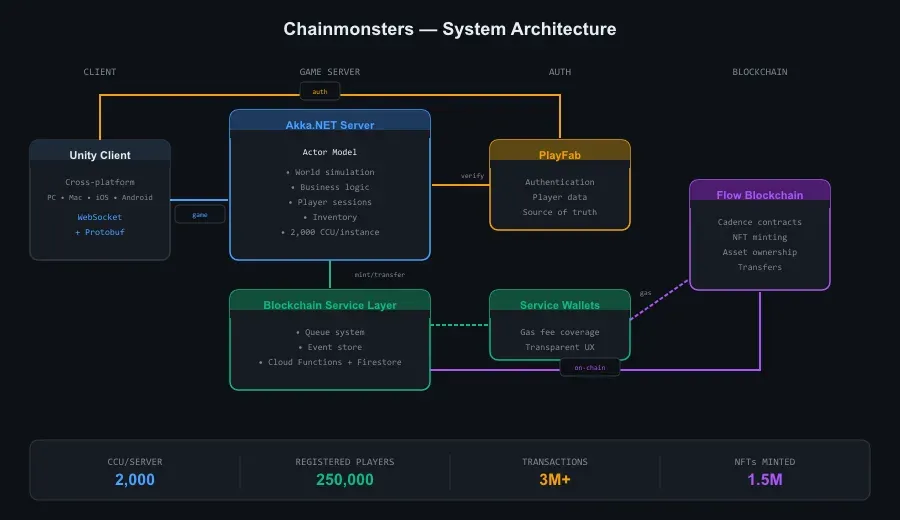
The game was cross-platform from the start: PC, Mac, iOS, and Android — all connecting to the same real-time world.
Blockchain Integration (Ethereum → Flow): The core design principle: players should never have to think about blockchain. No wallet popups, no gas fee prompts, no transaction confirmations interrupting gameplay.
I built a system where:
- Wallets were created silently in the background on account creation
- NFTs were pre-assigned to player accounts and only minted on-chain when transferred or sold
- Transaction costs were absorbed through service wallets
- Experienced users could access full wallet functionality and off-ramps when desired
This "blockchain-optional" UX had no precedent to follow. In 2018, blockchain gaming meant CryptoKitties — a collectible breeding game, not a real-time MMO. We weren't improving on existing patterns; we were inventing them.
We launched on Ethereum in 2018, making Chainmonsters one of the first publicly playable Unity games with blockchain integration. By 2021, scalability limits pushed us to Flow Blockchain — Cadence smart contracts enabled complex on-chain game logic, transaction throughput was orders of magnitude higher, and gas fees effectively disappeared for players.
Cross-Chain Infrastructure: The migration wasn't a clean cut. We operated across Ethereum, Flow, and ImmutableX simultaneously, requiring:
- Custom queuing systems (Cloud Functions, workers, Google Firestore)
- Event sourcing for full auditability and replay capability
- Bulk minting pipelines processing 100 NFTs simultaneously
- Cross-chain asset tracking and verification
Over the game's lifetime, we processed more than 3 million blockchain transactions.
What Lived On-Chain: Creatures, unique collectibles, cosmetics, and special items. The design philosophy: anything with genuine scarcity or player-to-player trade value belonged on-chain. Everything else stayed in traditional databases for performance.
What Made This Hard
Real-Time MMO + Asynchronous Blockchain: MMOs demand sub-second responsiveness. Blockchain confirmations take seconds to minutes. Reconciling these two realities — ensuring gameplay felt instant while maintaining blockchain integrity — required careful architecture. Pre-assignment, optimistic updates, and robust queuing made it work, but the edge cases were brutal to debug.
Building the Team: Chainmonsters was self-funded until the 2020 Kickstarter (€100,000) and 2021 NFT sale ($1.1 million USD). That capital allowed me to hire and manage a team of 15: 3 artists, 2 developers, 1 tech artist, 1 VFX artist, 1 writer, 1 composer, 1 web developer, 1 designer, 2 support staff, 1 social media manager, and 1 accountant. My cofounder Lysander Haupt served as Art Director, managing art production and outsourcing pipelines.
Scaling from solo founder to 15-person studio while shipping a live MMO was its own challenge entirely separate from the technical work.
War Stories: Unity 2021 was not a stable engine version. One week before our Beta release, I had to cut major visual features that simply wouldn't render correctly — an engine bug, not a performance issue. Two years later, I upgraded to Unity 6 and the features worked perfectly without a single code change. Sometimes the timing is just wrong.
The night before 2021 Beta launch, I was unsatisfied with the state of the campaign. I stayed up and wrote and scripted the entire 2-hour story myself. Not sustainable, but it shipped.
Results
- 250,000 registered players
- 3+ million blockchain transactions processed
- Cross-platform: PC, Mac, iOS, Android
- Funding: €100K Kickstarter (2020), $1.1M NFT sale (2021)
- Team: Scaled to 15 people
- Press: Featured in GamesWirtschaft, BlockchainGamer.net, PlayToEarn, and international gaming outlets
- Outcome: Acquired by Spielworks GmbH in 2023; game remains live
Chainmonsters proved that blockchain gaming could prioritize player experience over speculation. We built for a market that was still maturing — the infrastructure and audience caught up later.
-> later expanded into TapMonsters...
Cofounder: Lysander Haupt (Art Director)